
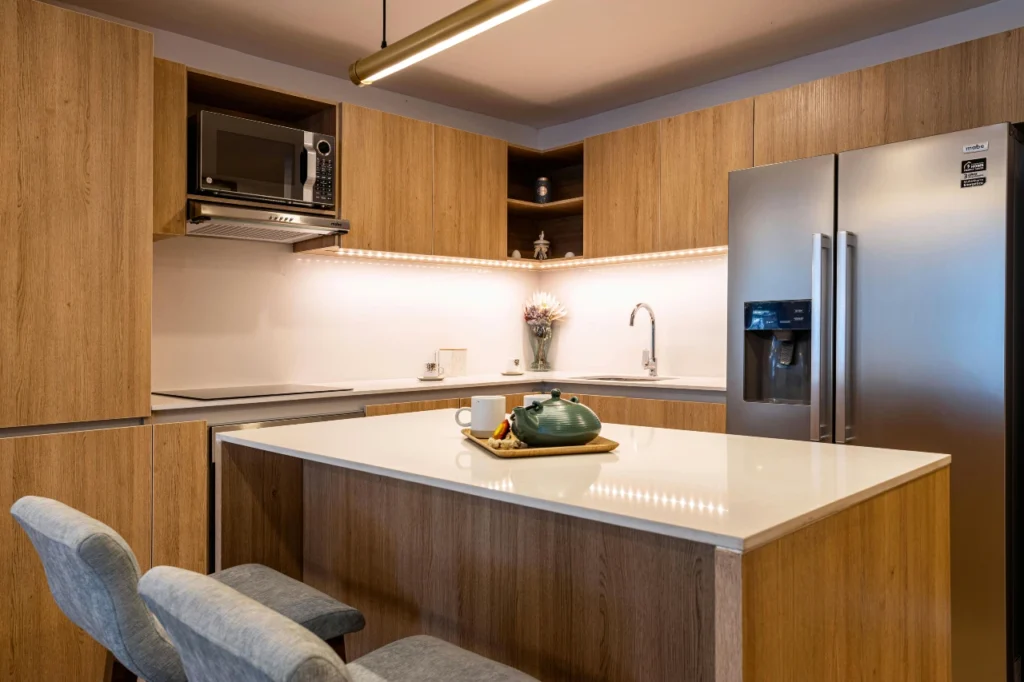
Your kitchen cabinets take up more visual space than almost anything else in the room. So when they start looking tired — whether it’s peeling veneer, outdated door styles, or a finish that screams 1998 — it’s hard to ignore. The question most Houston homeowners face at that point is simple: do I reface or replace?
Both options can transform your kitchen. But they’re very different in terms of cost, timeline, and what they actually accomplish. This guide breaks it all down so you can make the right call for your home and your budget.
Cabinet refacing means keeping your existing cabinet boxes — the frames, shelves, and structure — while replacing everything you actually see. That includes the doors, drawer fronts, and hardware, plus applying a new veneer or laminate to the exposed face frames.
The result looks like a brand-new kitchen. The process, however, is far less invasive than a full replacement. There’s no demolition, no disposal of old cabinetry, and no need to temporarily empty your entire kitchen for weeks on end.
Here’s what the refacing process typically involves:
Your existing cabinet boxes are inspected and repaired if needed. New veneer or laminate is applied to the face frames. Brand-new doors and drawer fronts are installed in your chosen style and finish. New hardware — hinges, pulls, knobs — is added as the finishing touch.
The whole process usually takes three to five days. Most homeowners can keep using parts of their kitchen throughout the project.
Cabinet replacement is exactly what it sounds like — everything comes out and new cabinets go in. The old boxes, doors, and hardware are removed and disposed of. New cabinets, whether stock, semi-custom, or fully custom, are installed from scratch.
Replacement makes sense when the cabinet boxes themselves are in bad shape — warped, water-damaged, or structurally compromised. It also makes sense when you want to change your kitchen layout, add an island, or reconfigure storage in ways that the existing footprint simply can’t accommodate.
Full replacement is a bigger project. It typically takes two to four weeks, involves more trades (plumbing and electrical work may need to be coordinated), and costs significantly more. But when the situation calls for it, there’s no substitute.
This is usually where the conversation gets real. Here’s a straightforward breakdown:
Cabinet refacing generally runs between $4,000 and $9,000 for a typical Houston kitchen. The range depends on the number of cabinets, your choice of materials (wood veneer vs. laminate), and the door style you select. It’s a significant investment, but a fraction of full replacement.
Cabinet replacement typically falls between $12,000 and $25,000 or more, depending on whether you go with stock cabinets, semi-custom, or fully custom cabinets built to your exact specifications. Labor, removal, and disposal costs factor in on top of the materials themselves.
When you do the math, refacing can save you anywhere from $8,000 to $15,000 or more compared to a full replacement — while still delivering a dramatically updated kitchen. For budget-conscious homeowners who want a real visual transformation without a full gut renovation, refacing is often the smarter financial move.
It’s also worth noting that many homeowners choose to finance their kitchen updates. If upfront cost is a concern, explore financing options for kitchen and bath remodeling to understand what monthly payment structures might look like for your project.
Refacing is the right choice when your cabinet boxes are structurally solid. If the frames are square, the shelves are holding up, and there’s no significant water damage or warping, there’s no good reason to throw them away. You’d be paying for demolition and disposal of perfectly functional material.
Refacing also makes sense when you’re happy with your current kitchen layout. If the flow works, the storage is adequate, and you just want a fresher look, refacing delivers exactly that. New doors in a shaker style, a crisp white or navy finish, and updated hardware can make your kitchen look like a completely different room.
From a budget standpoint, refacing is a natural fit for homeowners who want to increase their home’s appeal before selling — or who are planning a broader renovation in phases and want to address the kitchen now without a full overhaul.
There are situations where replacement isn’t just preferable — it’s necessary.
If your cabinet boxes show signs of water damage, mold, or structural failure, no amount of new doors will fix the underlying problem. You need to address the foundation before the finish.
Replacement also becomes the right answer when you want to change your kitchen’s footprint. Adding cabinets where there weren’t any, removing a peninsula, reconfiguring the work triangle, or making room for a larger appliance — these are layout changes that refacing can’t accomplish. The box has to change for the layout to change.
Finally, if your current cabinets are a non-standard size and finding matching replacement doors for refacing would be impractical, replacement may actually simplify the process.
A good remodeling contractor will walk you through both options honestly after seeing your kitchen in person. If someone pushes you toward full replacement without first evaluating your cabinet boxes, that’s worth questioning.
This one doesn’t get talked about enough. When you reface instead of replace, you keep hundreds of pounds of wood and material out of the landfill. A typical kitchen’s worth of cabinets generates substantial construction waste when demolished — and most of it isn’t recyclable in any practical sense.
Refacing is a genuinely sustainable choice. You’re working with what’s already there, which is almost always more resource-efficient than starting from scratch. For homeowners who care about reducing their environmental footprint without sacrificing quality or aesthetics, refacing aligns well with those values.
Some refacing materials — particularly wood veneers from responsibly sourced suppliers — carry certifications that speak to their environmental standards. It’s worth asking your contractor about material sourcing if this matters to you.
One of the most common misconceptions about cabinet refacing is that your design options are limited. They’re not. The selection available through professional refacing is extensive.
Door styles range from classic raised panel to clean-lined shaker to flat-front slab doors that suit modern and transitional kitchens. Shaker remains the most popular choice in Houston right now — it’s versatile, timeless, and works with almost any design direction.
Finishes include painted wood in virtually any color, stained wood that shows natural grain, thermofoil for a smooth and durable surface, and laminate options that can mimic wood, stone, or solid color. Matte finishes have been gaining ground over high-gloss in recent years, though the right choice depends entirely on the rest of your kitchen.
Hardware is the jewelry of your cabinets — and the right pulls or knobs make a real difference. Brushed brass and matte black have been trending in Houston kitchens, though brushed nickel remains a safe and enduring choice that ages well.
If you want to explore current design directions before committing to a style, our kitchen and bath remodeling resource page is a good starting point. You can also browse the ABF blog for more project inspiration and practical guidance.
This is one of the clearest practical advantages of refacing.
A cabinet refacing project for a standard Houston kitchen typically takes three to five days. You’ll have limited kitchen access during that window, but it’s a manageable disruption — nothing like a full renovation.
Full cabinet replacement, by contrast, takes two to four weeks. That includes cabinet fabrication lead time (which can run longer for custom orders), installation, and any associated work like countertop replacement, plumbing reconnection, or tile repair around the new cabinets.
If you’re planning around a holiday, an event, or a tight schedule, the timeline difference between refacing and replacement is a significant practical factor.
The best way to figure out which option is right for your kitchen is to have a professional look at what you’re working with. Cabinet box condition, current layout, your design goals, and your budget all factor into the recommendation — and there’s no one-size-fits-all answer.
ABF Remodeling works with Houston homeowners on both cabinet refacing and full kitchen remodels, and we’ll give you an honest assessment of what makes sense for your specific situation. No pressure toward the more expensive option if refacing is the right fit.
Explore our kitchen and bath remodeling services, read more on our blog, or call us directly at 281-855-3400 to schedule a consultation. Your kitchen update — at whatever scale makes sense — starts with a single conversation.
Copyright © 2026 A Beautiful Floor, Inc. DBA ABF Remodeling. All Rights Reserved. | Privacy Policy